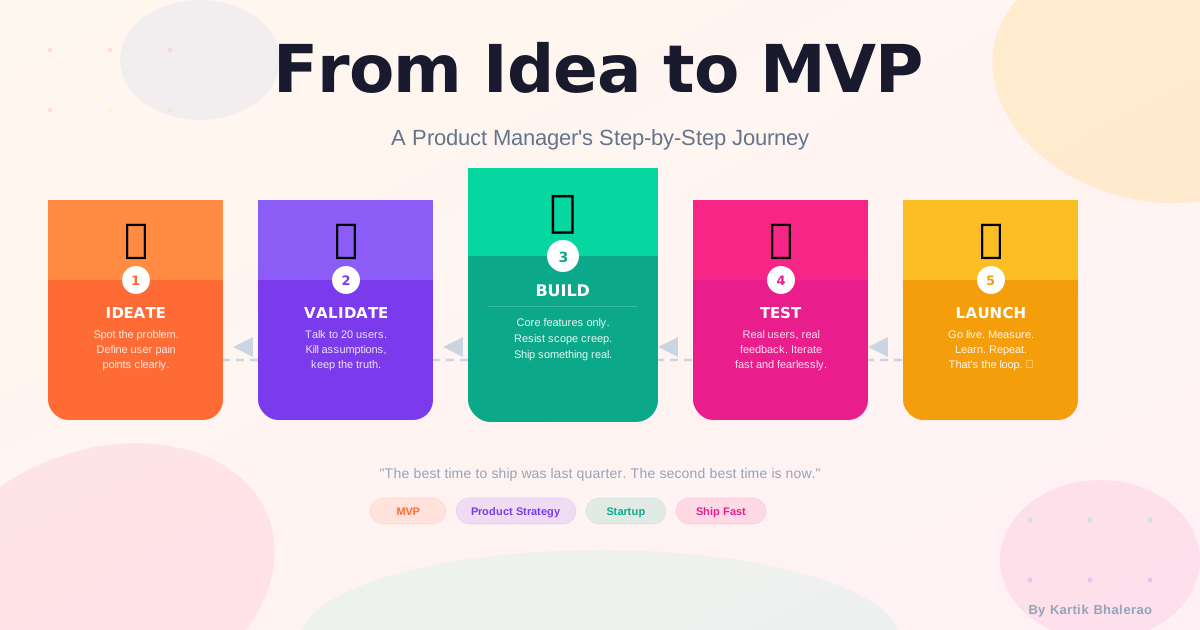
Step-by-step guide to building your first product from concept to launch
Introduction
Taking a product from initial idea to minimum viable product (MVP) is one of the most exciting and challenging aspects of product management. It requires balancing vision with reality, user needs with technical constraints, and speed with quality.
This guide walks through the complete journey from idea validation to MVP launch, based on real experiences and lessons learned.
Phase 1: Idea Validation (Weeks 1-2)
Problem Definition
Before building anything, ensure you're solving a real problem:
Key Questions:
- Who exactly has this problem?
- How are they currently solving it?
- How painful is this problem?
- Are they willing to pay for a solution?
Validation Methods:
- Customer interviews (at least 20-30)
- Online surveys and forums
- Competitive analysis
- Market size estimation
Target Audience Research
Create Detailed User Personas:
- Demographics and psychographics
- Current behaviors and pain points
- Technology comfort level
- Budget and decision-making process
Example Framework:
Persona: Sarah, Marketing Manager
- Age: 28-35, works at mid-size company
- Problem: Spends 5+ hours/week on manual report generation
- Current solution: Excel and manual data gathering
- Pain level: High (affects other priorities)
- Budget: $50-200/month for time-saving tools
Phase 2: Solution Design (Weeks 3-4)
Core Value Proposition
Define Your MVP's Core Value:
- What's the #1 thing your product does better than alternatives?
- What would users miss most if your product disappeared?
- Can you explain the value in one sentence?
Feature Prioritization Framework
Use the MoSCoW Method:
- Must Have: Core features without which the product fails
- Should Have: Important but not critical for launch
- Could Have: Nice-to-have features for future versions
- Won't Have: Features explicitly excluded from MVP
User Journey Mapping
Map the Critical Path:
- Discovery: How users find your product
- Onboarding: First-time user experience
- Core Usage: Primary value delivery
- Retention: Reasons to come back
Phase 3: Technical Planning (Weeks 5-6)
Technical Architecture Decisions
Key Considerations:
- Scalability requirements
- Security and compliance needs
- Integration requirements
- Performance expectations
MVP-Focused Approach:
- Choose proven technologies over cutting-edge
- Plan for iteration, not perfection
- Focus on core functionality, defer optimization
Resource Planning
Team Structure for MVP:
- 1-2 Developers (full-stack preferred for speed)
- 1 Designer (can be part-time)
- 1 Product Manager (you!)
- Optional: 1 Marketing/Growth person
Timeline Estimation:
- Add 50% buffer to initial estimates
- Plan for weekly releases
- Build in time for user testing and iteration
Phase 4: MVP Development (Weeks 7-16)
Agile Development Process
Weekly Sprint Structure:
- Monday: Sprint planning and feature review
- Wednesday: Mid-sprint check-in
- Friday: Sprint demo and retrospective
Key Principles:
- Ship weekly, even if features aren't perfect
- Prioritize user feedback over feature completion
- Focus on end-to-end user journeys
Continuous User Feedback
Feedback Collection Methods:
- Weekly user interviews (3-5 users)
- In-app feedback tools
- Usage analytics and heat maps
- Beta user community
Acting on Feedback:
- Categorize feedback: bugs, usability, feature requests
- Prioritize based on frequency and impact
- Communicate changes back to users
Phase 5: Pre-Launch Preparation (Weeks 17-18)
Beta Testing Program
Beta User Recruitment:
- 20-50 engaged users from your validation interviews
- Clear expectations about product maturity
- Structured feedback collection process
Testing Focus Areas:
- Core user journey completion rates
- Bug identification and severity
- Feature usage patterns
- Performance under realistic load
Launch Strategy
Soft Launch Approach:
- Limited user base (100-500 initial users)
- Invite-only or early access program
- Focus on learning over growth
Success Metrics Definition:
- Primary: Core value delivery (e.g., task completion rate)
- Secondary: Engagement (e.g., weekly active users)
- Tertiary: Growth (e.g., referral rate)
Phase 6: MVP Launch (Week 19)
Launch Day Execution
Pre-Launch Checklist:
- ✅ All critical bugs fixed
- ✅ Analytics tracking implemented
- ✅ Customer support process ready
- ✅ Backup and recovery plans tested
Communication Strategy:
- Email announcement to beta users
- Social media and blog post
- Personal outreach to key prospects
- Press release (if appropriate)
Post-Launch Monitoring
First Week Focus:
- Monitor critical errors and user-blocking issues
- Track user onboarding completion rates
- Respond to user feedback within 24 hours
- Document all issues for prioritization
Common MVP Mistakes to Avoid
1. Feature Creep
Problem: Adding "just one more feature" before launch
Solution: Stick to your must-have list ruthlessly
2. Perfectionism
Problem: Waiting for the product to be "ready"
Solution: Ship when it delivers core value, not when it's perfect
3. Building in Isolation
Problem: Not getting user feedback during development
Solution: Show work-in-progress to users weekly
4. Ignoring Technical Debt
Problem: Shortcuts that make future development impossible
Solution: Balance speed with sustainable code practices
Measuring MVP Success
Key Metrics to Track
Product Metrics:
- User activation rate (completed onboarding)
- Feature adoption rate
- Time to first value
- User retention (1-week, 1-month)
Business Metrics:
- Customer acquisition cost
- User lifetime value
- Monthly recurring revenue (if applicable)
- Net Promoter Score
Learning Objectives
Questions Your MVP Should Answer:
- Do users understand the value proposition?
- Can they successfully complete core tasks?
- Will they recommend it to others?
- What features do they need most urgently?
Next Steps: From MVP to Growth
Post-MVP Roadmap
- Weeks 1-4: Fix critical issues and improve core experience
- Weeks 5-8: Add most-requested features
- Weeks 9-12: Focus on growth and scalability
- Beyond: Expand to adjacent use cases
Scaling Considerations
- Team growth and process improvements
- Technical architecture evolution
- Customer success and support scaling
- Go-to-market strategy expansion
Lessons Learned
What Worked Well
- Early and continuous user feedback
- Weekly shipping cadence
- Focus on solving one problem really well
- Building relationships with early users
What I'd Do Differently
- Invest more time in technical architecture planning
- Start marketing earlier in the process
- Build analytics and tracking from day one
- Document decisions and learnings better
Conclusion
Building an MVP is about learning fast and efficiently. The goal isn't to build the perfect product, but to validate your assumptions and create a foundation for future growth.
Success comes from staying focused on user value, shipping regularly, and iterating based on real feedback. Every MVP is different, but the principles of user-centricity, rapid iteration, and continuous learning remain constant.
What's your experience with building MVPs? Share your lessons learned and challenges faced in the comments below.