AI
Loops Engineering for Product Development: How to Increase AI Efficiency
13 min readJul 26, 2026
8 min left
0% read
A new breed of product manager is emerging — one who doesn't just spec features, but deploys AI directly into workflows, decisions, and customer interactions. Here's what that shift means for the future of product.
For most of the last decade, product management followed a predictable rhythm. Talk to customers. Write PRDs. Prioritize the roadmap. Coordinate with engineering. Launch, measure, and repeat. The process wasn't elegant, but it worked, because software was stable. Once a feature shipped, its behavior stayed fixed until someone deliberately changed it.
AI has quietly broken that assumption. Today's products can reason, generate, decide, and adapt in real time based on every interaction they handle. The product is no longer just the interface you ship. It's the intelligence running underneath it, and that intelligence is always changing, always improvable, and always one bad output away from eroding user trust.
This shift is creating a challenge that most product teams aren't built to handle. The question is no longer "what feature should we build next?" It's a harder, more continuous one:
How do we continuously improve the intelligence users interact with every day?
That's the question that's driving a new kind of product manager into existence. Not someone sitting behind dashboards waiting for quarterly reviews. Someone embedded with customers, evaluating AI behavior in real workflows, redesigning processes, and shipping improvements every week, sometimes every day. They're starting to be called Forward-Deployed AI Product Managers, and they may be the most important new role in product right now.
The "forward-deployed" model has existed in enterprise software for a long time, companies like Palantir famously embedded engineers directly with customers to build solutions in context, rather than from a distance. The Forward-Deployed AI PM borrows that same philosophy and applies it to the AI product layer.
Instead of managing a requirements backlog, they manage learning loops. Instead of optimizing feature adoption, they optimize system intelligence. Their job isn't simply deciding what gets built, it's ensuring that the AI is creating measurable outcomes for real users in real workflows, and then improving it continuously based on what they observe.
In practice, this means operating across four domains simultaneously:
Traditional PM frameworks were designed around one core assumption: you decide what gets built, and then the product does what you built. The behavior is deterministic. Ship a button, the button works. Ship a search filter, the filter filters.
AI products violate this assumption completely. The behavior itself becomes part of the product, and unlike a button, it isn't fixed. Consider something as straightforward as an AI research assistant. The challenge isn't building the chat interface. That part is relatively simple. The challenge is everything else: improving response quality, increasing retrieval accuracy, reducing hallucinations, designing reasoning workflows, building user trust incrementally. These aren't feature problems. They're system behavior problems. And system behavior requires ongoing, continuous intervention.
In traditional SaaS, bad behavior is a bug you fix once. In AI products, behavior exists on a spectrum, and moving it in the right direction is a never-ending product job. The PM who can own that job is genuinely rare.
Most product teams aren't structured to handle this. They have sprint cycles designed for feature delivery, not continuous evaluation. They have analytics built for clicks and conversions, not task completion rates or hallucination frequency. The infrastructure for managing AI product quality simply doesn't exist yet at most companies, and the PM who can build and run that infrastructure is worth an enormous amount.
The comparison that captures this most clearly isn't about tools or frameworks, it's about what the PM role is actually for.
The shift isn't from hard to easy, or from slow to fast. It's from a model where the PM decides what gets built and then monitors results, to a model where the PM is continuously operating the system that produces results. That's a meaningful change in what the job actually is, and it's happening whether or not most product organizations are ready for it.
The emergence of this role isn't a trend. It's a response to a genuine organizational gap. AI adoption is accelerating faster than most companies' operating models can keep up with.
For Indian PMs specifically, that 92% figure should land harder than it might elsewhere. The users you're building for are already deeply embedded in AI workflows. They're not waiting for you to educate them, they're showing up with expectations shaped by tools like Gemini, Copilot, and ChatGPT already baked into their daily routines. That's a different kind of user, and it demands a different kind of PM.
Traditional product development moved in long cycles. Customer feedback flowed into a product team, got prioritized, got built by engineering, and shipped, often months later. The feedback loop was slow by design because software releases were expensive and risky.
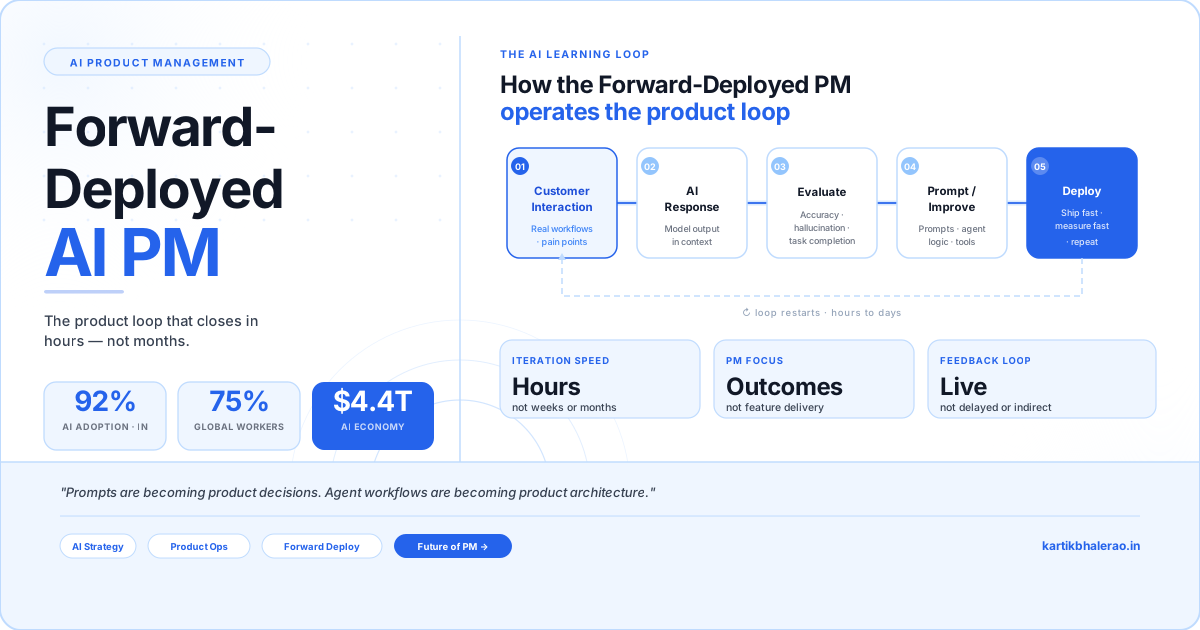
AI products compress this dramatically. When a prompt can be improved and deployed in an afternoon, or an agent workflow can be restructured in a week, the economics of iteration change entirely. The loop looks fundamentally different:
The highlighted steps, evaluation and improvement, are where Forward-Deployed AI PMs live. These are the highest-leverage points in the loop, and they require someone who understands both the customer context and the AI system well enough to translate one into improvements in the other.
What this means in practice: prompts are becoming product decisions. Agent workflows are becoming product architecture. Evaluation systems are becoming the new product analytics. If you can't engage meaningfully with all three, you can't run the loop effectively.
Knowing the loop isn't enough. Forward-Deployed AI PMs also need visibility across the full product stack, not as engineers, but as system designers who understand how each layer affects user outcomes.
Startups have always won by learning faster than incumbents, not by outspending them. In the AI era, that advantage has compounded. The organizations seeing the highest impact from AI, according to McKinsey's research, are the ones continuously iterating across multiple functions, not running isolated experiments and waiting for results.
A Forward-Deployed AI PM is essentially a dedicated learning engine. They stay close enough to customers to catch failures early. They understand the system well enough to diagnose root causes accurately. They have the operational fluency to deploy improvements quickly. And critically, they sit at the intersection of customer insight and product execution, which means every learning cycle actually converts into a meaningful change.
The distance between "we heard something isn't working" and "we fixed it" shrinks dramatically with this kind of PM involved. For an early-stage startup, that compression is often the difference between finding product-market fit and running out of runway chasing the wrong signals.
Here's where it gets uncomfortable: Forward-Deployed AI PMs can become dangerously tactical.
When your daily job is evaluating AI outputs, tweaking prompts, redesigning agent workflows, and chasing quality improvements, it's genuinely easy to lose weeks optimizing a system that's solving the wrong problem. The feedback loops in AI are so short and so satisfying, you fix a prompt, you see a measurable improvement, you feel productive, that it can mask the absence of strategic thinking entirely.
The questions that tend to go unasked when everyone is deep in the learning loop: Why does this product exist? What's our actual competitive advantage, the AI, the data, the workflow, the distribution? What market are we creating, and are we creating it, or just improving our position in someone else's? What should we be building next that we aren't building at all?
AI doesn't eliminate the need for product strategy, it makes it more important, because the tactical loop is so fast and so rewarding that strategy gets crowded out unless someone is deliberately protecting space for it. The strongest Forward-Deployed AI PMs aren't choosing between strategy and execution. They're the ones who can hold both at the same time.
This is also why the role is genuinely hard to hire for. Someone who's great at prompt engineering and agent workflows but has no product instinct will optimize local maxima forever. Someone who's great at strategy but can't engage with the technical stack will be perpetually dependent on engineers for decisions that should be theirs. The combination, strategic clarity and operational depth, is rare, and it's what actually makes the role work.
If you're a PM reading this and wondering what it takes to operate this way, the honest answer is that the technical bar is lower than it looks, and the product bar is higher than most job descriptions admit.
You don't need to be an ML engineer. But you do need to get hands-on with AI tooling, not as a demo, but as a practitioner. Build something with an LLM API. Work with an agent framework. Set up a simple evaluation pipeline, even a manual one. Use tools like n8n, Apify, or LangChain for workflow automation. The goal isn't to build production systems; it's to develop enough mechanical sympathy to have productive conversations with engineers and to diagnose failures without needing someone to translate for you.
On the product side: go deeper on evaluation thinking than you probably have. Most PM interviews test prioritization and user research fluency. Almost none test whether you can design a meaningful evaluation rubric for an AI feature. Start there. Learn what "task completion rate" actually means operationally. Learn why hallucination rate is hard to measure and what proxies people use. This is where the real leverage is.
And find a role or project where you're close enough to actual AI deployment to run the loop yourself, not supervising someone else who runs it. The learning compounds when you're operating it directly.
Skills to learn or adapt if you want to operate as a Forward-Deployed AI PM:
The most valuable product managers over the next decade won't be the ones who write the best PRDs. They'll be the ones who understand how to manage living systems, products that reason, adapt, and improve continuously. The title might keep changing. The fundamental shift it represents won't. AI products need operators, not just planners. The PMs who figure that out early will define what the role looks like for everyone who comes after them.
Similar Topics