AI
Loops Engineering for Product Development: How to Increase AI Efficiency
13 min readJul 26, 2026
10 min left
0% read
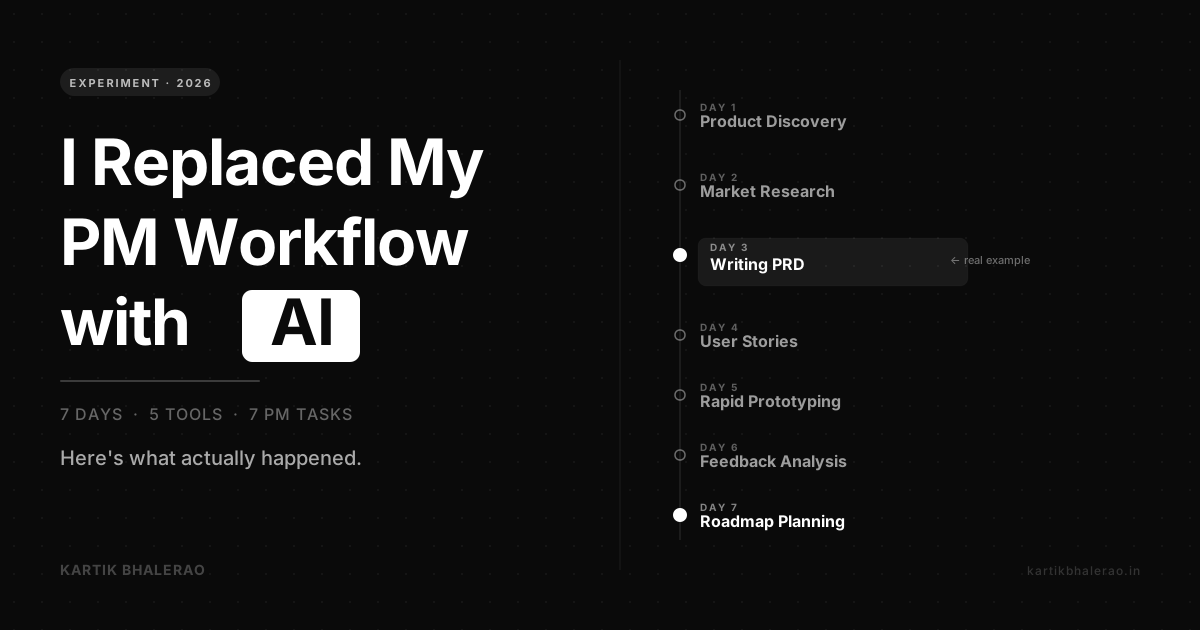
For 7 days, I replaced key parts of my PM workflow with AI tools. Here's where AI genuinely helped, where it struggled, and what it means for the future of Product Management.
Product Management sits at the intersection of technology, business, and user experience.
But in reality, a large portion of a Product Manager's time is spent on operational tasks such as:
With the rapid rise of AI tools like Claude Code, OpenAI Codex, Cursor, and other AI assistants, I started wondering:
What if AI could handle a large part of a Product Manager's workflow?
To explore this idea, I ran a small experiment.
For 7 days, I replaced several parts of my PM workflow with AI tools to understand:
Before starting the experiment, my workflow usually looked like this:
Many of these tasks involve structured thinking and documentation, making them ideal candidates for AI support.
Suggested timestamps to reference:
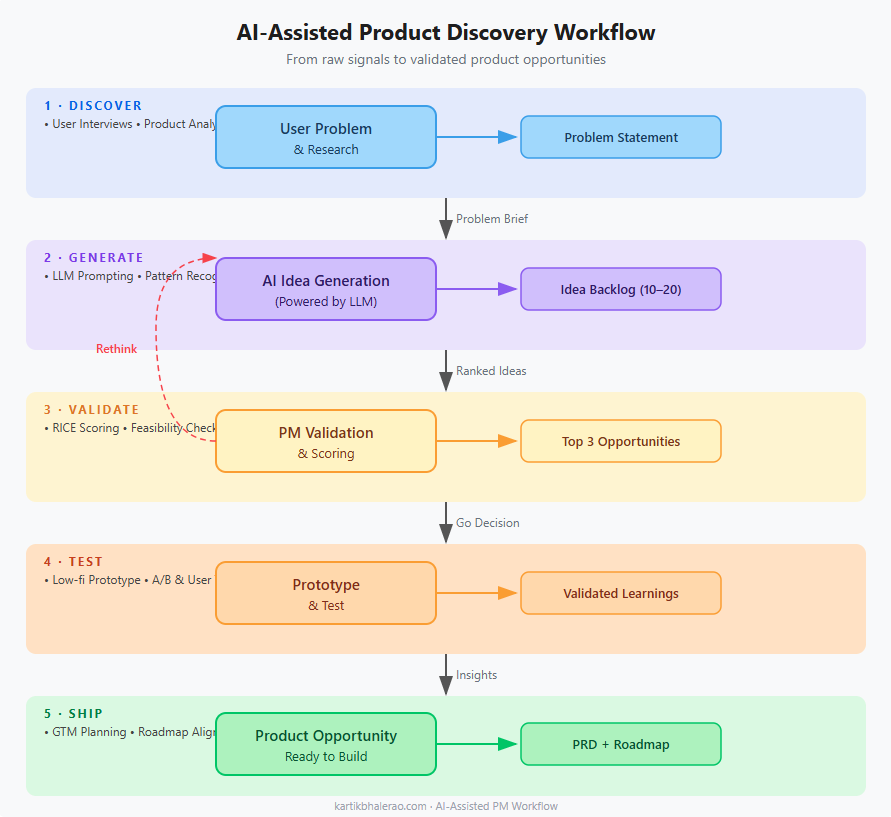
The first step in building any product is identifying the right problem to solve.
Instead of manually researching reports and forums, I used prompts like:
What are the biggest financial problems faced by users in India?
Identify opportunities for fintech products.
Within seconds, AI generated multiple opportunity areas such as:
AI is excellent for idea generation and brainstorming, but validating those ideas still requires real user research and domain expertise.
Market research normally requires hours of analyzing competitors and reading reports.
Instead, I asked AI to analyze competitors such as:
Example prompt:
Analyze the product strategy of Google Pay, Paytm and PhonePe.
Identify product gaps in the Indian fintech ecosystem.
A task that normally takes 3 hours was completed in 15 minutes.
However, I still verified the insights manually.
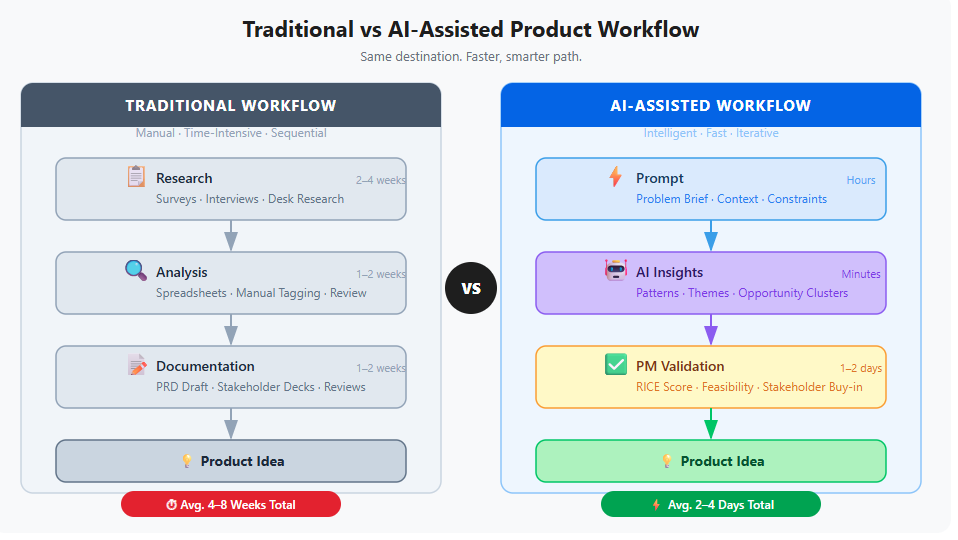
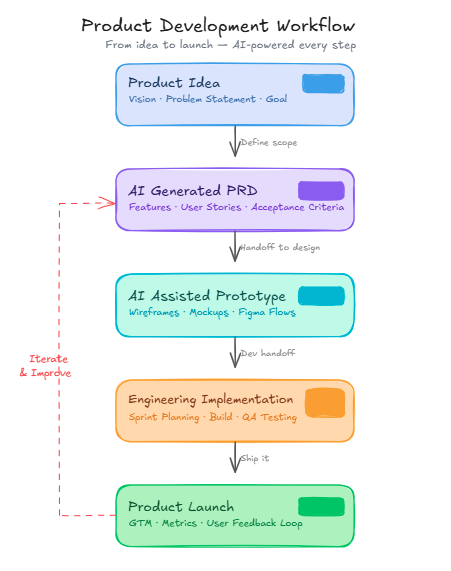
Writing Product Requirement Documents (PRDs) is one of the most time-consuming tasks for Product Managers.
Prompt example:
Create a PRD for a Credit Score Tracker feature in a fintech app.
Include:
- problem statement
- user stories
- success metrics
- technical considerations
AI generated a structured PRD draft with:
AI is extremely powerful for generating structured documentation quickly, but it still requires human refinement.
Want to see what a real AI-assisted PRD looks like in practice? I wrote a full PRD for Chatly using exactly this process.
View Chatly PRDUser stories are another repetitive but essential part of product documentation.
Prompt example:
Generate user stories and acceptance criteria for a credit score tracking feature.
Example output:
As a user, I want to check my credit score so that I can monitor my financial health.
This significantly reduced the time spent writing documentation.
One of the most interesting discoveries during this experiment was how AI helps with rapid prototyping.
Tools like Cursor and Codex helped generate:
This significantly reduced the gap between:
Product Idea → Prototype
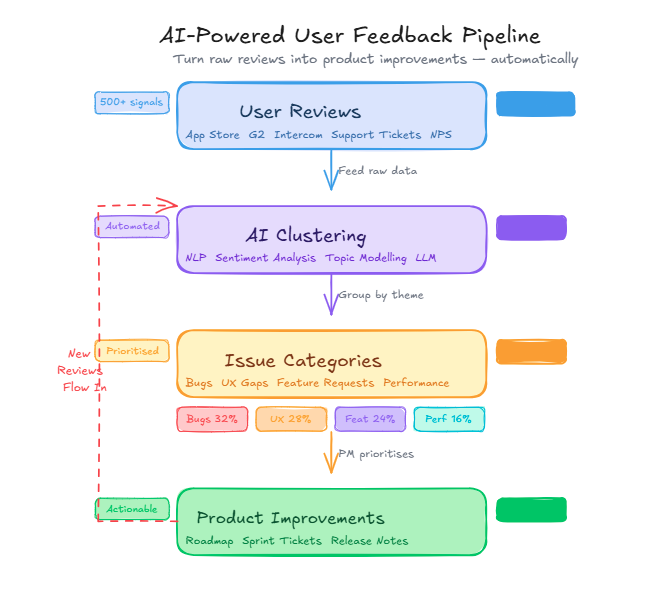
AI was also extremely useful for analyzing large amounts of user feedback.
Prompt example:
Analyze 200 user reviews and identify the top product issues.
AI categorized feedback into themes such as:
This normally requires manual tagging and analysis. AI dramatically reduced the effort.
Finally, I used AI to generate a product roadmap.
Prompt example:
Create a 6 month roadmap for a fintech credit score product.
Prioritize features based on impact and effort.
AI generated a roadmap structure including:
While not perfect, it served as a great starting point.
AI proved extremely useful for:
These tasks represent a significant portion of operational PM work.
Despite its strengths, AI still cannot replace core Product Manager responsibilities such as:
These require human judgment and contextual understanding.
The biggest insight from this experiment:
AI will not replace Product Managers.
But Product Managers who effectively use AI will outperform those who don't.
In the future, PMs will spend less time writing documents and more time focusing on:
AI will act as a product co-pilot, helping teams build and ship products faster.
Similar Topics