8 min left

    0% read

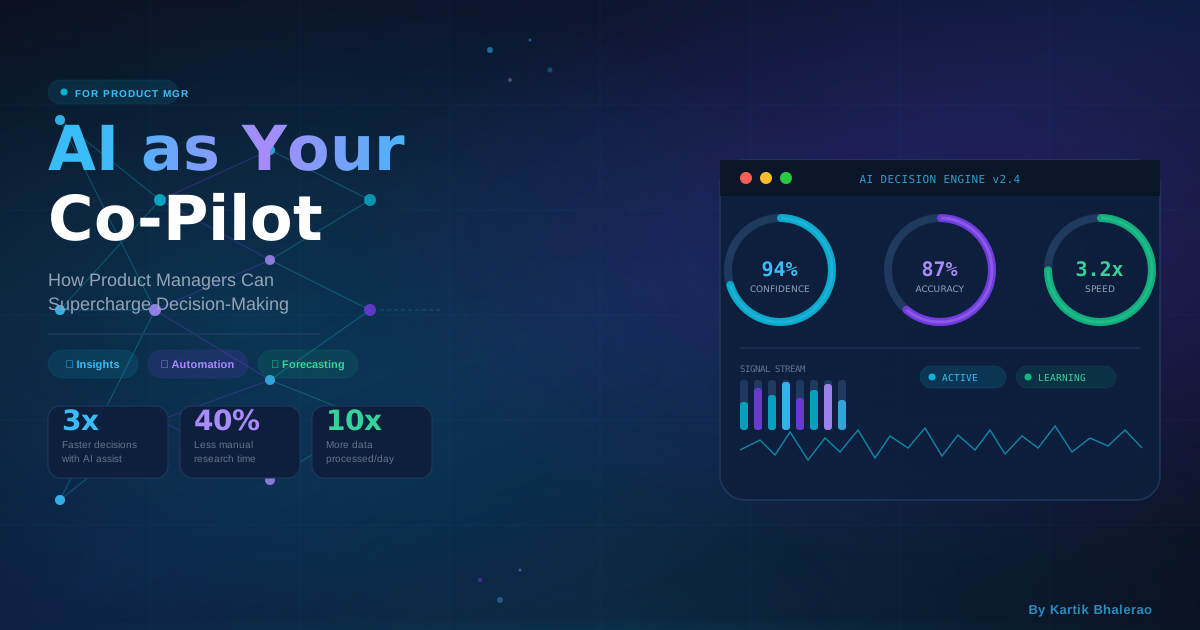
    AI as Your Co-Pilot: How Product Managers Can Supercharge Decision-Making with AI
    AI
    JUL 1, 2025

    AI as Your Co-Pilot: How Product Managers Can Supercharge Decision-Making with AI

    AI is revolutionizing product management by providing deep insights, automating processes, and enhancing forecasting accuracy.

    AIProduct ManagementDecision MakingAnalytics

    šŸš€ Introduction

    Product managers today face an avalanche of data, rapidly evolving customer demands, and increasing pressure to ship faster and smarter. The good news? You don't have to navigate it alone.

    "AI is revolutionizing product management by providing deep insights, automating processes, and enhancing forecasting accuracy."

    The key premise: AI is an augmentation tool, not a replacement for human judgment.

    AI as Co-Pilot
    AI as Co-Pilot

    šŸ† The Evolving Role of AI in Product Management

    AI enhances product management through five key capabilities:

    • Processing large datasets to reveal hidden patterns
    • Improving forecasting through predictive analytics
    • Enhancing feature prioritization using impact and effort data
    • Automating repetitive administrative tasks to free up PM time
    • Optimizing user experience via A/B testing and heatmaps

    šŸ”„ AI-Powered Decision-Making Process

    A four-step workflow for using AI in your PM toolkit:

    1. šŸ“„ Data Collection, User feedback, market trends, competitor analysis
    2. 🧠 AI Analytics, Sentiment analysis, predictive modeling, anomaly detection
    3. šŸ“Š Decision Support, AI-driven insights, scenario planning, feature prioritization
    4. āœ… Final Decision, PM reviews recommendations and refines strategy

    AI-Powered Decision-Making Process
    AI-Powered Decision-Making Process

    šŸ“Œ Traditional vs. AI-Powered Decision-Making

    DimensionTraditional PMAI-Powered PM
    Data ProcessingManual spreadsheetsAutomated analytics at scale
    ForecastingGut feel + past trendsPredictive models on live data
    Feature PrioritizationCommittee votesAI-scored impact vs. effort
    User InsightsPeriodic surveysReal-time sentiment analysis
    SpeedWeeks per cycleHours per iteration

    "AI leverages big data to provide actionable insights."

    🧐 1. Sentiment Analysis

    AI-driven tools analyze customer feedback across multiple channels to gauge emotions. Capabilities include:

    • Classifying feedback as positive, neutral, or negative
    • Tracking sentiment trends over time to measure brand perception shifts
    • Surfacing recurring pain points across thousands of reviews instantly

    AI models can forecast:

    • Future customer preferences based on historical patterns
    • Product demand across different geographic regions
    • Market shifts and competitive movements before they fully emerge

    šŸŽÆ 3. AI-Driven Feature Prioritization

    AI-based tools evaluate features by analyzing:

    • User demand, What are customers asking for most?
    • Development effort, How complex is the build?
    • Business impact, What's the projected ROI?

    AI-Driven Feature Prioritization
    AI-Driven Feature Prioritization

    🌟 AI in Action: Real-World Case Studies

    ⚔ Case Study 1: AI-Powered A/B Testing

    An e-commerce company utilized AI to optimize their checkout process by:

    • Analyzing behavior heatmaps across thousands of user sessions
    • Predicting which UI changes would boost conversions
    • Recommending design modifications based on real-time interactions

    Result: Significant uplift in checkout completion rates without manual hypothesis testing.

    šŸš€ Case Study 2: AI-Assisted Feature Rollouts

    A SaaS company leveraged AI to:

    • Segment users by engagement levels automatically
    • Recommend personalized feature rollouts to the right user cohorts
    • Measure new feature impact through automated analysis pipelines

    Result: Faster time-to-insight, more targeted rollouts, and better adoption metrics.

    🧠 The Human Touch: AI as an Assistant, Not a Replacement

    Three principles for balancing AI with human expertise:

    1. Use AI for data-driven insights, but rely on human judgment for interpretation
    2. Leverage AI for efficiency, while basing final decisions on business context and values
    3. Trust AI recommendations, but always validate through user research and direct feedback

    šŸ”§ Tools for AI-Powered Product Management

    ToolUse Case
    AmplitudeBehavioral analytics and user journey analysis
    MixpanelEvent tracking and funnel optimization
    ProductboardAI-assisted feature prioritization
    Notion AIAutomated documentation and synthesis
    ChatGPT / ClaudeResearch, PRD drafting, competitive analysis
    HotjarHeatmaps and session recordings

    šŸš€ Future of AI in Product Management

    Emerging developments to watch:

    • Generative AI supporting product ideation and rapid brainstorming
    • AI-powered strategy simulations predicting long-term product impact
    • Voice AI technologies analyzing customer feedback in real-time
    • Autonomous agents handling end-to-end research pipelines

    šŸŽÆ Conclusion

    AI provides substantial value through data-driven insights and task automation, but product managers must treat it as a complementary co-pilot, not the captain.

    Strategic intuition and user empathy should remain central to every decision.

    Embrace AI in product management and supercharge your decision-making today, just remember to keep your human judgment firmly in the cockpit.

    šŸ“– Read More

    šŸ‘‰ Full Article on Medium

    šŸ’¬ How are you using AI in your PM workflow? Let's connect and share!

    Similar Topics

    AI

    Loops Engineering for Product Development: How to Increase AI Efficiency

    13 min readJul 26, 2026
    AI

    Forward-Deployed AI PMs Are Changing How Products Get Built

    8 min readJun 9, 2026
    AI

    I Tried Replacing Traditional User Personas with AI — Here's What I Learned

    9 min readMay 28, 2026